Selenite vs. Quartz: What's the Difference
4 September 2026
- buying guide
- selenite
- quartz
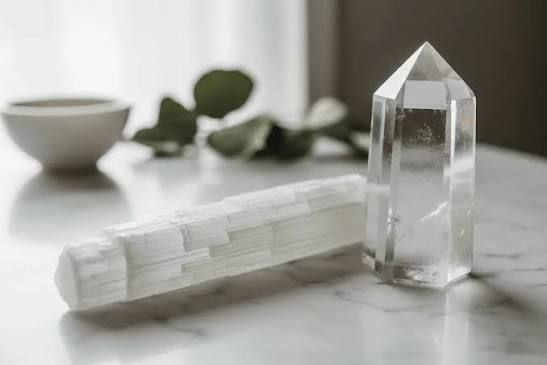
Selenite and quartz turn up on the same wellness shelf, but they're not related stones at all: selenite is a form of gypsum (calcium sulfate), while quartz is silicon dioxide — different mineral families, different hardness, different care needs.
What selenite actually is
Selenite is a crystal form of the mineral gypsum, prized for its pearly, almost glowing white sheen and the way it forms in flat plates, wands and towers with a soft, striated surface. It's one of the softest minerals sold in the crystal trade — roughly 2 on the Mohs hardness scale, about the same as a fingernail. That softness is exactly why selenite plates are popular as a base for charging other crystals: it's easy to shape into flat, elegant forms, and it's what gives selenite pieces their satiny, silky-smooth feel.
What quartz actually is
Quartz is silicon dioxide, one of the hardest and most common minerals on Earth (7 on the Mohs scale — hard enough to scratch glass and steel). Agate, amethyst, citrine, rose quartz and clear quartz points are all quartz-family stones; what changes between them is trace minerals and crystal structure, not the base chemistry. Where selenite is soft and satin-finished, quartz pieces are hard, glassy and take a genuine polish.
The practical differences
Hardness: quartz (7) will scratch selenite (2) — never store them touching in the same pouch.
Water: selenite is water-soluble over time and will dull, pit or dissolve with repeated contact — wipe it dry, never soak it. Quartz is completely fine with water.
Sunlight: quartz points can be left in sun with no issue. Selenite can yellow or become brittle with prolonged direct sun exposure.
Look and feel: selenite is translucent, silky and almost glowing under light; quartz is glassier, harder-edged and takes facets and points naturally.
Which one for what
Selenite plates and towers work well as a display piece or a base to set other stones on — not for anything that gets handled roughly or wet often. Quartz — clear, rose, citrine or agate — is the more durable everyday choice for jewellery, pendulums and pieces that get carried or worn.
See our selenite plates, orgone pyramids and quartz-family pieces across home décor, astrology & healing and wellness — each listing states the actual stone, not just "crystal."